Monthly recurring pentests.
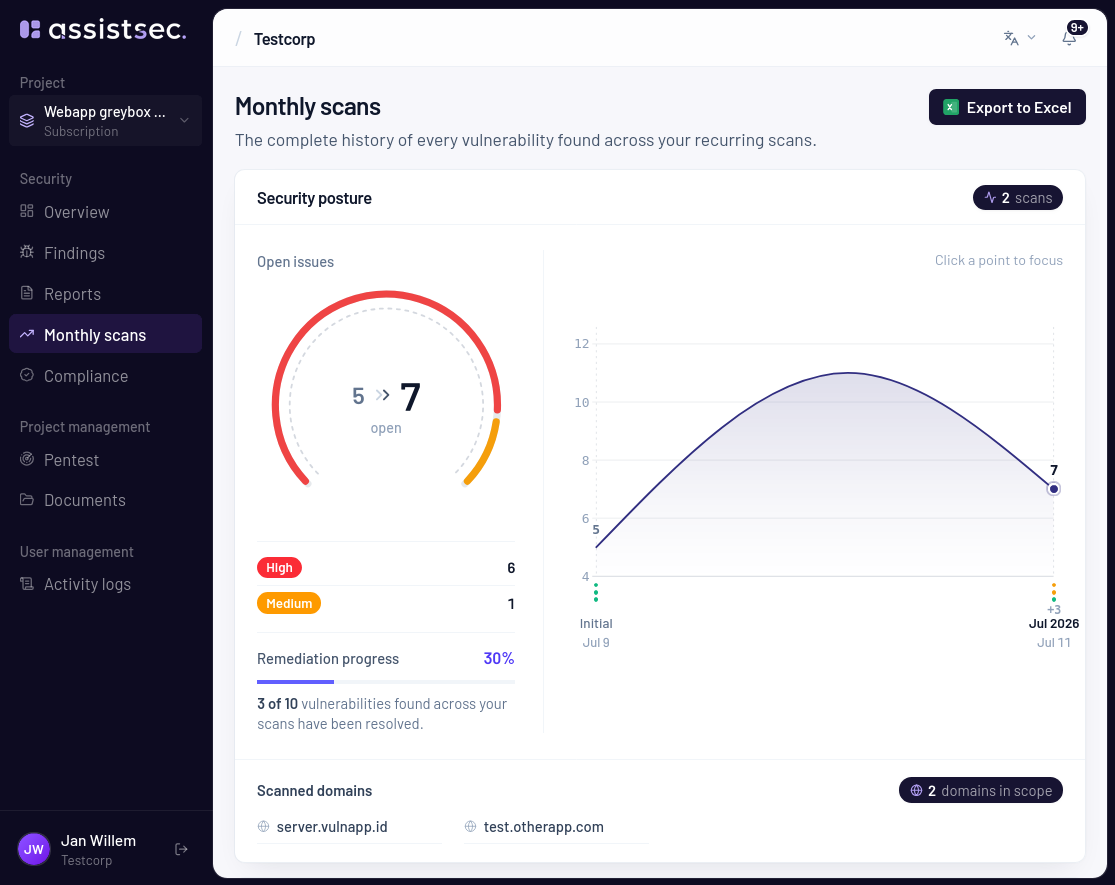
The initial pentest establishes your baseline. From then on, ARGUS rescans your web applications on the first Monday of every month and shows exactly what changed since the last scan.
- A fixed cadence: the first Monday of every month, planned in advance.
- Every scan compared against the baseline: new, still open, resolved, reappearing.
- Findings mapped to the ISO 27001 controls they touch, with dates.
What is agentic pentesting?
The same engagement, carried out by hundreds of specialized agents working under our pentesters.
Hundreds of agents, attacking like pentesters
Autonomous agents work through your applications, APIs and infrastructure the way a real attacker would, discovering and exploiting weaknesses at machine speed.
Every finding is validated before you see it
Separate agents re-exploit each candidate finding to confirm it is real. What reaches you is validated, with a working proof of concept, not a pile of unchecked alerts.
A report the same day
What used to take weeks now takes hours. Results are validated and exported as the report you need: a management summary, a customer-facing version or the full auditor report.
One-off pentests vs monthly pentests
A pentest tells you where you stood on the day it ended. The monthly scans keep that answer current, without commissioning a new engagement every time something ships.
The initial pentest
- Pentesters and specialized agents test the full scope in depth.
- Every finding is validated by an expert before it reaches you.
- The result becomes the baseline all later scans measure against.
Every month after
- The same scope, rescanned on the first Monday of the month.
- We review what changed, and deliver a clear overview to make this understandable.
- Fixes that quietly regress come back as reappearing, with history.
Multiple finding states to keep track
No archaeology through old PDFs to work out what is new. The comparison is done for you, and each state answers one question.
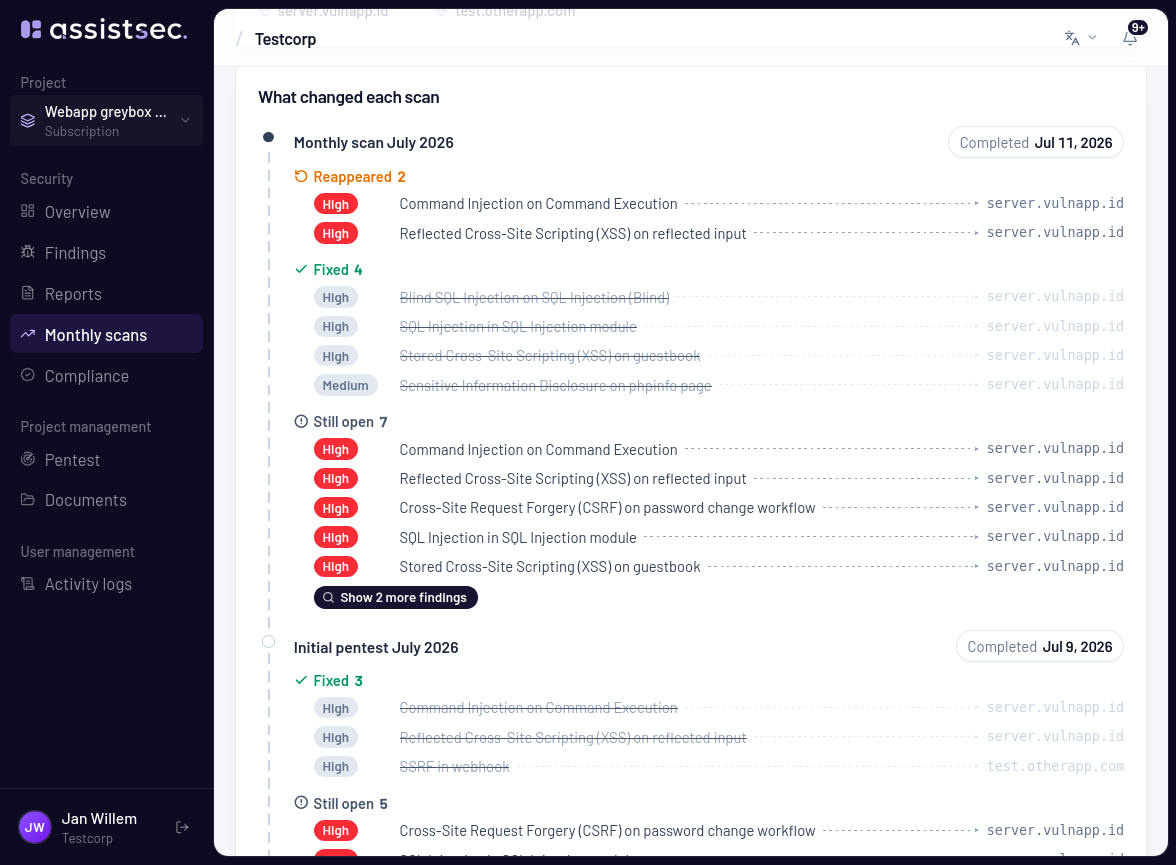
- New this scanFound this scan and absent from every earlier one. Starts its own record.
- Still openReported before, not fixed yet. Its age is visible, so nothing quietly slips.
- FixedNo longer reproducible this scan. The fix date stays on the record.
- ReappearedFixed once, back again. It reopens with its full history rather than arriving as new.
See whether security is improving or slipping
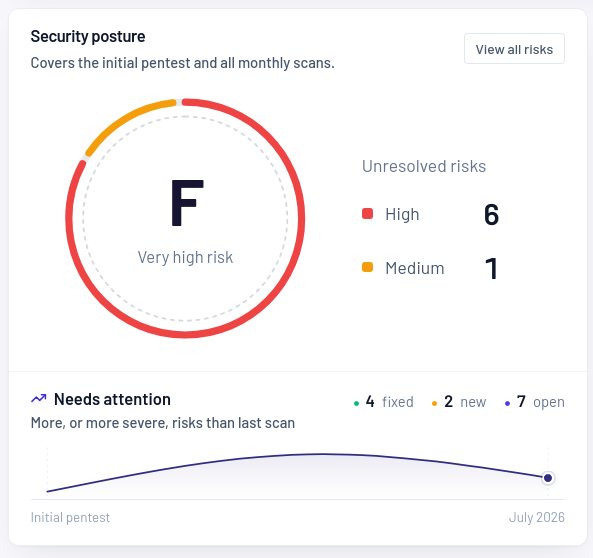
Every scan adds a data point. The trend view plots open findings across months, so a quarter of steady fixes shows up as a falling line and a risky release shows up in the month it happened.
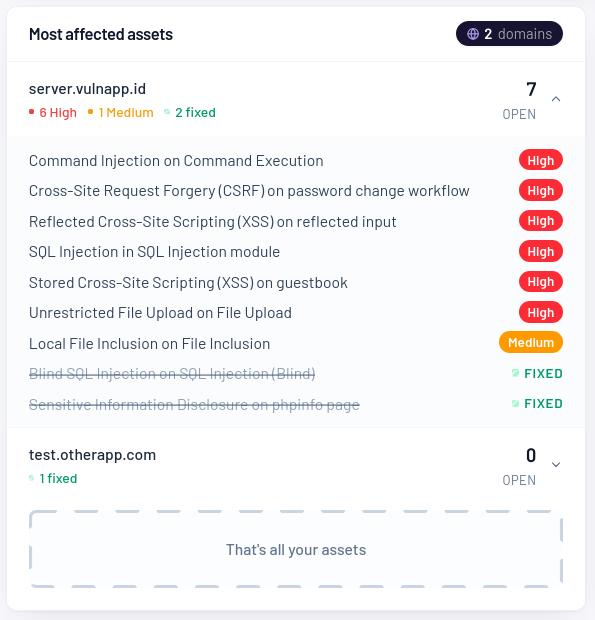
Multiple applications, one overview
Scope one application or twenty. Each keeps its own baseline, schedule and history, and the overview adds them up so you can see where risk concentrates.
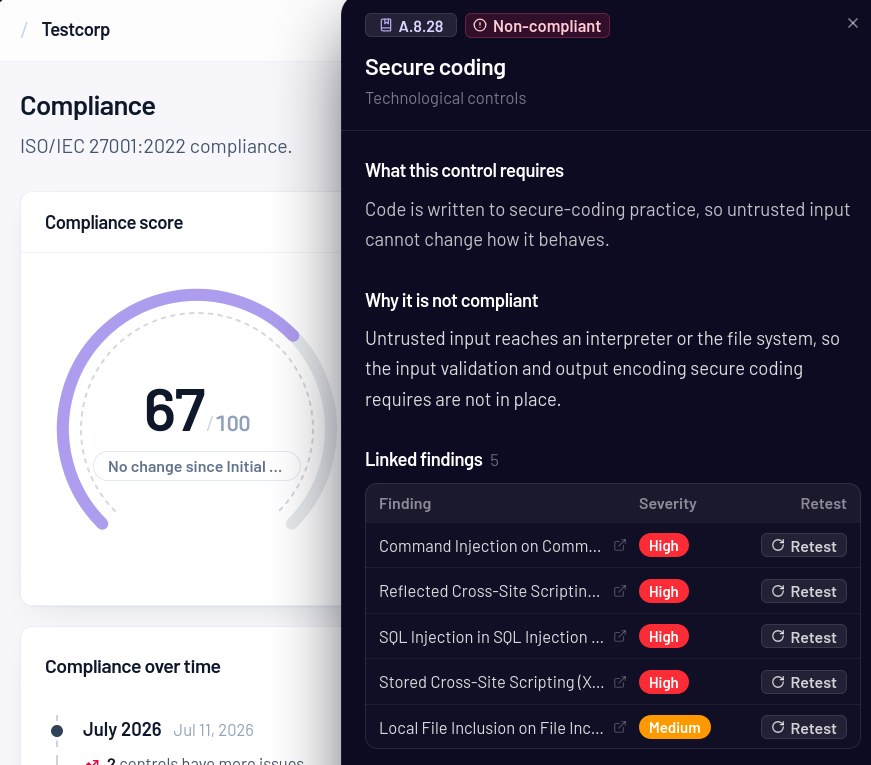
Findings, mapped to ISO 27001 controls
Each finding names the Annex A controls it touches, with dates and evidence attached. When an auditor asks how a control is tested in practice, the answer is a list you open, not a memory.
Frequently asked questions
What do the monthly scans cover?
The applications agreed in your scope, on the same surface as the baseline pentest. That is what makes results comparable month over month.
Why the first Monday of the month?
A fixed, predictable date. Your team knows when results land, every scan is exactly a month from the last, and the trend stays honest because the interval never drifts.
Does the ISO 27001 mapping make us compliant?
No. It shows which controls each finding touches, which supports your audit trail. Compliance and certification remain between you and your auditor.


Interested in a pentest?
Discover how AI-backed pentesting gives your organization faster and more thorough insight into vulnerabilities.
Contact us